Learning computational fluid dynamics can seem challenging at first because it combines fluid mechanics, mathematics, numerical methods, geometry preparation, and simulation software. However, with a structured approach, beginners can gradually develop the skills required to create reliable and advanced CFD simulations. An ansys fluent learning path provides a practical framework for progressing from basic concepts to professional-level simulation work.
Understanding the Foundations of CFD
Before opening ANSYS Fluent, it is important to understand the fundamentals behind CFD. Computational fluid dynamics uses numerical methods to solve problems involving fluid flow, heat transfer, and related physical phenomena.
Beginners should become familiar with concepts such as pressure, velocity, density, viscosity, turbulence, conservation of mass, momentum, and energy. A basic understanding of differential equations is also helpful because CFD software converts physical equations into numerical solutions.
You do not necessarily need to be an advanced mathematician to begin learning Fluent. However, understanding what the governing equations represent will help you interpret simulation results instead of simply accepting software-generated values.
Starting With ANSYS Fluent Basics
The next stage of the ansys fluent learning path is becoming comfortable with the Fluent environment and its general workflow. Beginners should first learn how a typical CFD project is organized.
A standard workflow involves creating or importing geometry, generating a computational mesh, defining materials and boundary conditions, selecting physical models, initializing the solution, running calculations, and post-processing results.
At this stage, learners should focus on understanding what each step accomplishes rather than trying to solve highly complicated engineering problems immediately.
Simple internal-flow examples are excellent starting projects. Pipe flow, channel flow, and basic mixing problems allow learners to understand velocity profiles, pressure changes, and boundary conditions without excessive complexity.
Learning Geometry and Mesh Generation
Mesh generation is one of the most important skills in CFD. A good physical model can still produce unreliable results if the computational mesh is poorly designed.
Learners should understand the difference between structured and unstructured meshes, cell quality, skewness, orthogonal quality, refinement, inflation layers, and local mesh sizing.
The goal is not simply to create the largest possible number of cells. Instead, learners should understand where refinement is necessary. Regions with strong velocity gradients, boundary layers, separation, wakes, and other important flow features often require additional resolution.
A useful exercise is to solve the same problem using several mesh densities and compare the results. This introduces the concept of mesh independence and helps learners understand how numerical resolution can affect CFD predictions.
Mastering Boundary Conditions
After learning meshing, the next important step is understanding boundary conditions. Fluent provides numerous boundary-condition options, and selecting the correct one requires an understanding of the physical problem.
Common conditions include velocity inlet, pressure inlet, pressure outlet, wall, symmetry, periodic boundaries, and mass-flow inlet. Learners should understand not only where to click in the interface but also why a particular condition is appropriate.
For example, an internal-flow problem may use a specified velocity or mass flow at the inlet and a pressure condition at the outlet. Walls may use no-slip conditions unless the physical situation requires something different.
Correct boundary conditions are essential because they define how the computational domain interacts with its surroundings.
Understanding Physical Models
Once basic Fluent operations are familiar, learners can progress toward selecting appropriate physical models. This is where the ansys fluent learning path becomes more technically demanding.
Users should learn when to use laminar versus turbulent models and become familiar with common turbulence approaches. Depending on the application, learners may eventually study models such as k-epsilon, k-omega, and SST formulations.
Heat-transfer simulations introduce additional concepts, including energy equations, thermal conductivity, temperature-dependent properties, radiation, and conjugate heat transfer.
At this stage, it is important to avoid selecting models simply because they are available. Every model should have a physical reason behind its selection.
Developing Solver and Convergence Skills
Running a simulation is not the same as obtaining a trustworthy solution. Learners must understand convergence and numerical stability.
Important concepts include residuals, solution monitors, initialization, iteration controls, discretization schemes, under-relaxation, and convergence criteria.
A simulation may appear to have converged numerically while still producing questionable engineering results. Therefore, learners should monitor quantities such as pressure drop, temperature, drag, lift, mass balance, or heat-transfer rates in addition to residuals.
Learning to diagnose unstable or slowly converging simulations is an important transition from beginner to intermediate CFD user.
Practicing With Realistic Engineering Projects
After mastering individual features, learners should begin combining their skills through complete projects. This is one of the most effective stages of an ansys fluent learning path.
Suitable projects can include airflow through ducts, flow around a vehicle, heat transfer through a component, cooling of electronic equipment, flow through valves, or external aerodynamics.
Each project should follow a repeatable process:
- Define the engineering question.
- Simplify the physical problem where appropriate.
- Create or prepare the geometry.
- Develop a suitable mesh.
- Select materials and physical models.
- Apply appropriate boundary conditions.
- Initialize and solve the model.
- Check convergence.
- Perform post-processing.
- Validate the results against analytical calculations, experimental data, or published references when possible.
This workflow teaches learners to approach CFD as an engineering method rather than simply a software exercise.
Advancing Into Turbulence and Complex Physics
Once learners are comfortable with standard simulations, they can move into more advanced topics. Turbulence modeling is an important area because many industrial fluid-flow problems involve turbulent behavior.
Advanced learners can investigate transient simulations, multiphase flows, combustion, species transport, radiation, porous media, rotating machinery, and fluid-structure interaction workflows.
Transient CFD introduces another dimension because the solution changes with time. Learners must understand time-step selection, temporal discretization, and the difference between physical transience and numerical instability.
Rotating machinery applications can introduce concepts such as moving reference frames and sliding interfaces, while multiphase simulations require additional knowledge of phase interactions and model selection.
Building Automation and Efficiency
Advanced Fluent users should eventually learn how to make simulation workflows more efficient. Repeating every task manually can become time-consuming, especially when performing design studies.
Automation can help users manage repeated simulations, parameter changes, and post-processing tasks. Learners can explore Fluent’s scripting and automation capabilities as their experience grows.
High-performance computing is another important area for advanced users. Large CFD models may require substantial computational resources, making parallel processing and efficient case setup valuable professional skills.
Learning Post-Processing and Result Interpretation
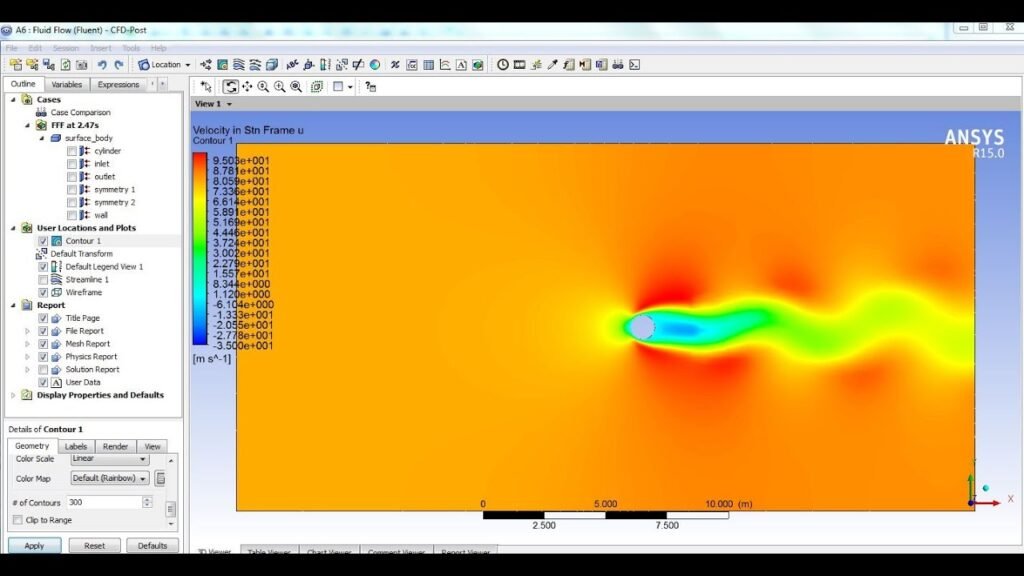
A strong CFD professional must be able to explain results clearly. Fluent provides tools for examining contours, vectors, streamlines, reports, surface data, and other quantities.
Beginners often focus heavily on colorful contour plots. Advanced users look beyond visual appearance and ask whether the results make physical sense.
For example, a pressure contour should be connected to the expected pressure distribution, while velocity patterns should be consistent with conservation laws and known flow behavior.
Quantitative reporting is especially important in professional engineering because decisions are usually based on numerical performance indicators rather than visual images alone.
Validation as the Final Skill
Validation and verification should become a central part of the learning journey. CFD results are numerical predictions, not automatically correct answers.
Verification examines whether the numerical implementation is solving the intended mathematical problem correctly. Validation asks whether the simulation represents real physical behavior accurately.
Learners should compare simulations with analytical solutions, benchmark cases, experimental measurements, or trusted reference data whenever available.
Developing this habit separates casual software users from engineers who can confidently use CFD for real decision-making.
Creating a Long-Term Fluent Learning Strategy
A successful ansys fluent learning path should progress gradually. Beginners should first establish CFD fundamentals, then learn geometry and meshing, followed by boundary conditions, physical models, solver controls, post-processing, and validation.
After that foundation is established, learners can specialize in areas such as aerodynamics, thermal management, turbomachinery, multiphase systems, automotive engineering, aerospace applications, or industrial process simulation.
The most effective approach is project-based learning. Instead of watching tutorials without practice, choose increasingly difficult problems and document each simulation. Record assumptions, mesh settings, models, convergence behavior, results, and lessons learned.
Over time, this creates a portfolio demonstrating practical CFD skills. The objective is not merely to learn where Fluent’s buttons are located. The real goal is to develop the ability to define engineering problems, construct appropriate computational models, evaluate numerical quality, interpret results, and communicate conclusions confidently.
Conclusion
An effective ansys fluent learning path takes learners from fundamental CFD knowledge to increasingly sophisticated simulation capabilities. Starting with fluid mechanics and Fluent fundamentals, learners can progress through geometry, meshing, boundary conditions, physical models, solver controls, post-processing, validation, and advanced multiphysics applications.
Consistent practice and progressively challenging projects are the keys to improvement. By combining theoretical understanding with hands-on simulation experience, beginners can build the confidence and technical judgment needed to move toward advanced CFD analysis and professional engineering applications.